
A few days ago I wrote:
One thing I care much much less about these days is anything ‘political’ within the rapid decay of the Civilized.
It’s more true than ever. I am viewing (and structuring) my life around the idea of avoiding societal pressure of any kind whenever possible (and running up against the frustrations involved in realizing how impossible that sometimes is).
I still care a lot (more than I should?) about how we got here and what to “do” about it at this late date.
And thus I continue to monitor the evolution of the Fellow Kid’s thinking on these matters (see the post dated 9 May).
The Real Dawn of Everything pt.2: the origins of tribalism, patriarchy and social conservatism
Two things that particularly interested me about this one.
1) He seems to be embracing a philosophical identity as a materialist, and so we differ sharply there.
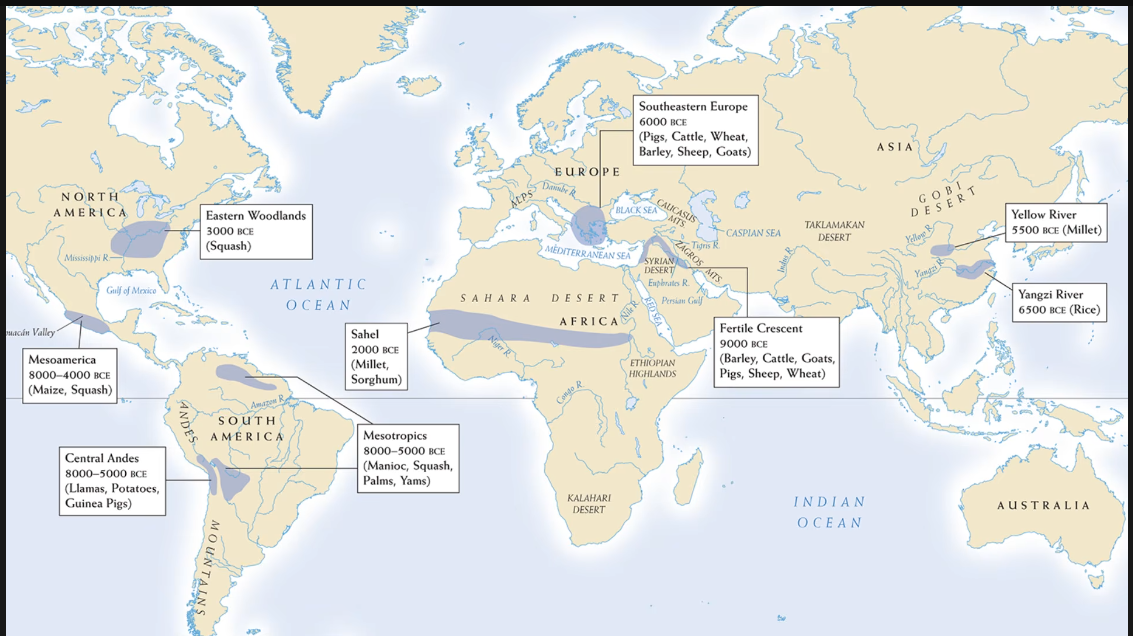
2) Way down in the weeds, he makes brief mention of a curious phenomenon. In his telling, no self-respecting hunter-gatherer would ever want to turn themselves into a farmer, unless it were a matter of life and death–the only alternative to starvation; extinction.
This telling cuts across the grain of my usual interpretation about sedentism and agriculture being a voluntary course of action, a function of being lured by a false promise of a better life for one’s offspring, and a free-will Mistake.
I doubt whether that distinction makes any substantial difference in the end.
But I do find it an interesting potential slight deviation from the genesis story I’ve been telling myself for a long time.
Make of that what you will.
Part Three is already out …
Personal or situational leaders/chief-like roles emerge (at the earliest) 12,000 Years Before Present (Natufians, Göbekli Tepe; in association with earliest agriculturally-based settlement)
Clear, durable hereditary elites and kingship arise regionally later: by 7000 YBP (Varna-type elite burials) and become fully institutionalized into states by 6000 YBP in Mesopotamia (the Uruk period: roughly 4100–3100 BCE, with Late/Late‑Uruk developments c. 3500–3200/3000 BCE when urban institutions, proto‑writing, and large‑scale administration are most evident.
The first empire is generally identified as the Akkadian, founded by Sargon of Akkad (c. 4300 YBP). It united many independent Sumerian and Akkadian city‑states under centralized rule. (But compare the formulation of a ‘Sumerian Civilization’ in about the same place at about the same time give or take a few hundred years.)
… and presumably Part Four is on the way soon.